


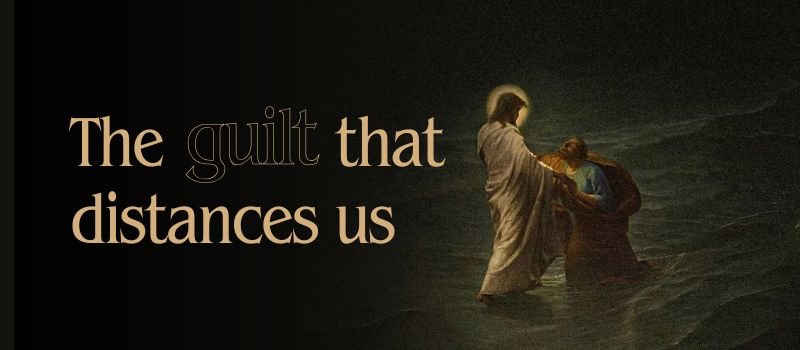
Many times, when we fail, the first feeling that arises is not repentance, but shame. It makes us retreat, fall silent, and distance ourselves from God, as if our mistake had made us unworthy of His presence. However, this reaction reveals something deeper: at some level, we still believe that the Gospel revolves around us. But the center was never us. It has always been Christ.
Accepted by works
“Hearing the man and his wife the sound of the Lord God as He was walking in the garden in the cool of the day, they hid from the Lord God among the trees of the garden. But the Lord God called to the man, ‘Where are you?’ He answered, ‘I heard You in the garden, and I was afraid because I was naked; so I hid.’”
Genesis 3:8–10
Since Eden, shame has been a human response to sin. When Adam and Eve sinned, they did not run toward God—they hid from Him. Guilt produced distance, and distance produced fear. Shame is born when we believe God looks at us through our failure rather than through His love.
When we fail and find it difficult to draw near, it reveals that we still think we are accepted by performance. But the Gospel is not a system of merit; it is a message of redemption. “Therefore, there is now no condemnation for those who are in Christ Jesus” (Romans 8:1).
Shame makes us look at ourselves, while grace invites us to look at Christ. The problem is not acknowledging the mistake, but allowing it to define our identity. The failure exists, but it does not have the final word. The cross has already spoken louder. While sin calls us away from God, He calls us through His love, continually.
We have already received
“This is love: not that we loved God, but that He loved us and sent His Son as an atoning sacrifice for our sins.”
1 John 4:10
Many times we believe we are loved because we pray, seek, obey, and remain. But the order of the Gospel is the opposite: we seek, pray, obey, and remain because we have already been loved. God’s love is not a response to our effort—it is its source. Our obedience is pure gratitude.
Grace precedes every human movement. Before any decision we made, He had already decided to love us. Before any response from us, He had already given Himself.
When we try to turn obedience into a bargaining tool, we distort the Gospel. We do not act to receive something from God, but in gratitude for what we have already received. “For it is by grace you have been saved, through faith—and this is not from yourselves, it is the gift of God—not by works, so that no one can boast.” (Ephesians 2:8–9).
Grace transforms
“Or do you show contempt for the riches of His kindness, forbearance and patience, not realizing that God’s kindness is intended to lead you to repentance?”
Romans 2:4
God’s grace does not produce complacency, but transformation. It does not constrain us through fear, but through love. The power and love of God move us with reverent fear—this is different from shame. Shame paralyzes, distances, and cools the heart. Fear pours out grace, and grace draws near, heals, and matures.
Failing does not make us unworthy, because we were never worthy to begin with. Everything has always been undeserved. And this is the most beautiful part of God’s grace.
What draws us close to God is not our perfection, but His. A surrendered heart, willing to rise again, change, and walk forward, becomes sensitive to the Father’s voice to receive everything He has already offered since before the foundation of the world. Our walk with Him does not change who God is, but it changes our steps.
The Gospel does not call perfect followers, but surrendered children—children who learn to discipline their desires, align their dreams, diminish the ego, and humble themselves before God. We are not the protagonists of the story. It is about Christ, His love, and His work. Grace trains us to live holy lives (Titus 2:11–12), with reverent fear, as we draw near to grace daily.


